
Skip to content

Not an official City of Nanaimo website.

Independent community site. Not affiliated with the City or any campaign.

Learn more about this site here

Not an official City of Nanaimo website.

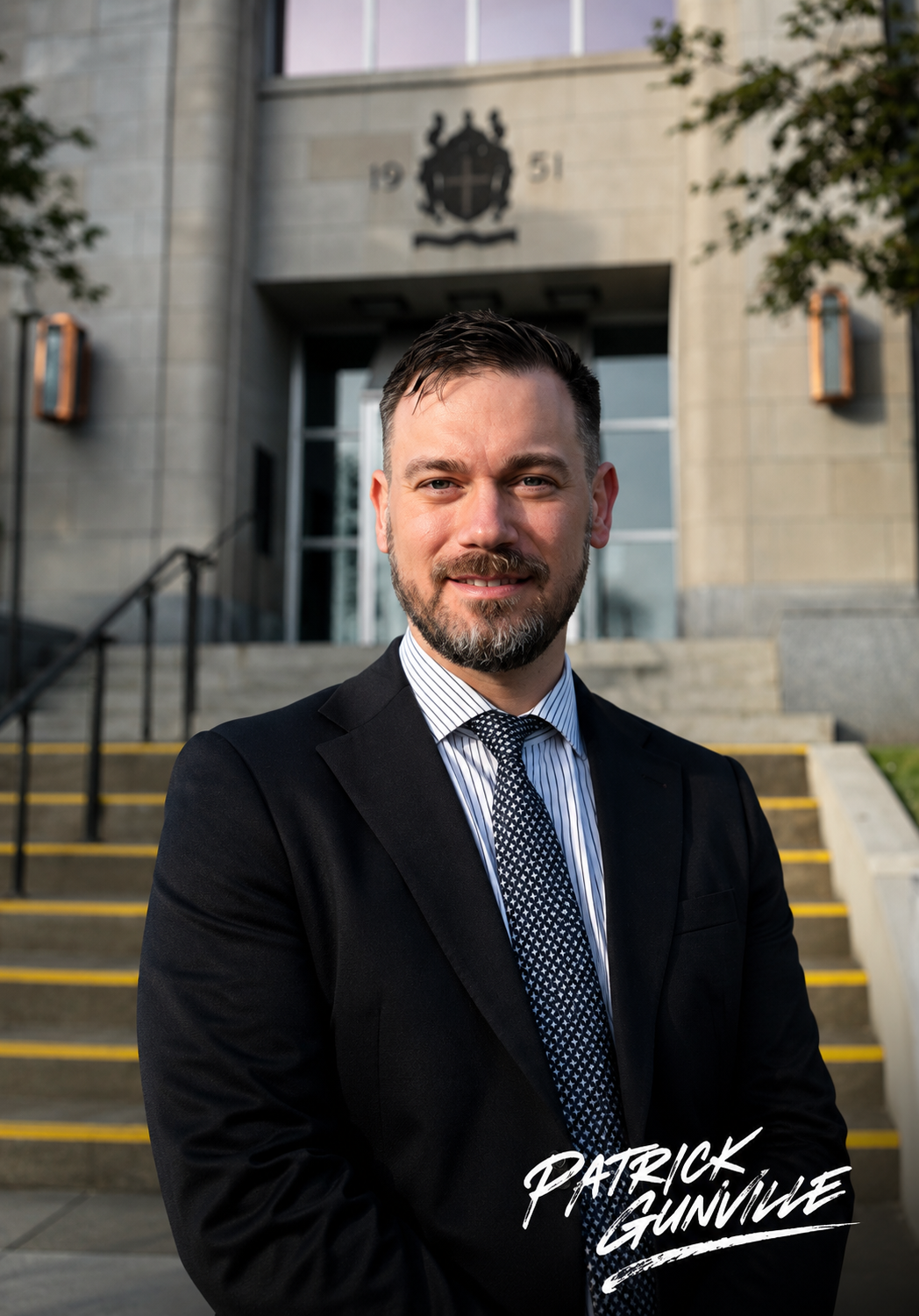
Patrick Gunville
Candidate for City Council

Patrick Gunville

Candidate statement

“I’m running for Council because I believe City Hall should make it easier—not harder—for families, businesses, and neighbourhoods to succeed.”

Gathered by Nanaimo Vote · patrickgunville.ca

Biography

Raised on Vancouver Island, Patrick Gunville is a Commercial Real Estate Advisor with CBRE, the world’s largest commercial real estate services firm, where he helps businesses buy, sell, lease, and develop commercial property throughout the Mid-Island region. After earning a Diploma in Legal Studies and a Bachelor of Arts in Criminology, Patrick built his career in downtown Vancouver with Cushman & Wakefield before returning home to Vancouver Island to help establish and grow CBRE’s Mid-Island presence from Nanaimo. Working every day with business owners, developers, investors, and entrepreneurs has given Patrick firsthand experience navigating zoning, development approvals, business licensing, and the many municipal processes that shape economic growth. That experience inspired him to become deeply involved in the community and advocate for practical, business-minded leadership at City Hall. Outside of his professional career, Patrick serves as Immediate Past President of the Nanaimo Executives Association, is an active member of the Greater Nanaimo Chamber of Commerce, sits on the Regional District of Nanaimo Board of Variance, serves on both the Liquid Waste and Solid Waste Management Plan Monitoring Committees, is part of the Nanaimo Prosperity Corporation’s Business Engagement initiative, and is a member of the Mid-Island Métis Economic Development Committee. Patrick believes Nanaimo’s best years are still ahead and is committed to building a city that is affordable, safe, economically competitive, and prepared for the future.

Gathered by Nanaimo Vote · patrickgunville.ca

Links

Profile last updated on

On the issues

What they've said publicly

Public statements are organized under common issue topics to make comparison easier, with links to their sources.

Mayor & City Councillor

Affordability

What is your approach to affordability and growth?

How Nanaimo can manage growth while addressing the cost of living, housing costs, and the infrastructure and services needed by current and future residents.

  1. "Every election, candidates promise to lower taxes. I’m not going to make that promise. The truth is, no councillor can honestly guarantee lower taxes. The cost of maintaining roads, water systems, police, fire protection and parks continues to rise every year. Pretending otherwise doesn’t help anyone. What I can promise is to focus on the real reason taxes continue to climb, and that’s because Nanaimo isn’t growing its tax base nearly fast enough. As a commercial real estate advisor, I’ve spent years working with businesses and investors who want to build here. I’ve seen projects delayed, cancelled, or moved elsewhere because the process became too uncertain, too expensive, or simply took too long. That’s not just frustrating for the people investing millions of dollars—it’s frustrating for every taxpayer who ends up carrying a larger share of the bill. Think about it this way. If the cost of running our city keeps increasing, but we aren’t adding enough new homes, businesses, and investment to share those costs, the math is simple. Existing taxpayers end up paying more. That’s why I believe the conversation shouldn’t begin with “How do we cut another few thousand dollars?” Of course we should spend responsibly. Every dollar matters, and I’ll always support common-sense budgeting. But trimming a few line items around the edges won’t solve the long-term problem if we aren’t growing Nanaimo’s economy at the same time. The better question is this: Why aren’t we creating more taxpayers? Nanaimo has every advantage. We’re the geographic centre of Vancouver Island. We have a deep-water port, an airport, rail, a growing university, and one of the best places in Canada to live. Businesses should be lining up to invest here. Developers should be submitting applications. Good projects should be moving through City Hall with confidence and certainty. Instead, too often the opposite happens. When investment goes elsewhere, we don’t just lose construction jobs. We lose future businesses, future homeowners, future taxpayers, and the opportunity to strengthen our local economy. That leaves everyone who’s already here paying a larger share of the costs. That’s why one of my priorities is making Nanaimo more attractive to investment—not for the sake of developers, but for the sake of every resident who wants a more affordable city and a stronger local economy. I’m not going to promise you lower taxes. I am going to work to reduce the pressure that keeps driving them higher. To me, that starts with welcoming responsible investment, approving good projects in a timely manner, creating better-paying jobs, and growing our tax base so the cost of running Nanaimo is shared by more people—not continually downloaded onto the same homeowners and businesses. That’s not an empty campaign promise. It’s simple economics."

    Gathered by Nanaimo Vote · patrickgunville.ca 09/27/2026
Mayor & City Councillor

Budget & Property Taxes

How should the City manage its budget and property taxes?

The City's annual budget and five-year financial plan, property tax increases, spending priorities and efficiency, reserves and debt, and how residents can see the value they get for their tax dollars.

No statement found

This does not mean the candidate has never made a statement. It means Nanaimo Vote has not found one for this specific issue, or the candidate has not provided one in response to it.

Mayor & City Councillor

Health Care

What role should local government play in health care infrastructure and access?

Hospital and health-service capacity, facilities and access, including municipal and regional advocacy and partnerships with health authorities and the Province.

No statement found

This does not mean the candidate has never made a statement. It means Nanaimo Vote has not found one for this specific issue, or the candidate has not provided one in response to it.

Mayor & City Councillor

Planning for Growth

How should the city plan land use, density, and infrastructure for growth?

Land use, density, development patterns and infrastructure capacity, including how neighbourhoods connect to jobs, services and transportation.

  1. "We’ve Forgotten How to Attract Investment In my last email, I talked about growing Nanaimo’s tax base. The idea is simple: when more homes are built, more businesses open, and more people invest in our community, the cost of funding the services we all rely on is shared more broadly. That strengthens our economy and reduces long-term pressure on existing taxpayers. But if Nanaimo has so many advantages, why aren’t we attracting more investment? This Is About More Than Permits and Process Whenever this issue comes up, people usually point to slow permits, complicated regulations, or City Hall bureaucracy. Those problems are real, and we already know many of the practical ways to address them: clearer expectations, better upfront guidance, published timelines, concurrent processing where practical, and more predictable decisions. Those improvements matter, but I don’t believe they address the underlying problem. This is about more than permits and process. This is about culture. As a commercial real estate advisor, I regularly work with business owners, developers, and investors considering projects throughout Vancouver Island. What I have learned is that communities cannot simply assume investment will come to them. Businesses have choices about where to expand. Developers have choices about where to build. Investors have choices about where to place their capital. Cities Have to Compete for Investment Every community is competing for businesses, entrepreneurs, jobs, development, and investment dollars. The successful ones understand that prosperity is not automatic. They actively work to become places where responsible investment is welcomed, respected, and encouraged. Too often, I believe Nanaimo has forgotten that we are competing. We speak about attracting investment, but our actions can send the opposite message. A new proposal can quickly become a community-wide controversy, with every possible objection examined before anyone seriously asks how the opportunity could benefit Nanaimo or how reasonable concerns could be addressed. Instead of beginning from a position of possibility, we too often begin from a position of doubt. Council must consider the public interest, and not every proposal should be approved. But there is a major difference between thoughtful review and approaching new businesses, developments, or private investment primarily as problems to be managed. When the process becomes unnecessarily adversarial, unpredictable, or political, investors take notice. The Opportunities We Lose Are Often Invisible Most businesses and investors will not publicly complain when they decide Nanaimo is too difficult. They will simply invest somewhere else. A developer pursues a project in another municipality. An employer expands in another region. An entrepreneur opens the next location in another city. Those lost opportunities rarely make the news because they never arrive here in the first place. We only experience the consequences: fewer homes, fewer jobs, less economic activity, and a smaller tax base supporting the public services our community expects. That is why becoming more competitive matters to everyone, not only to the business community. A stronger private sector means more employment, more housing, more customers for local businesses, and more taxpayers sharing the cost of running the city. A Culture of Unreasonable Hospitality I believe Nanaimo should strive to become known for what could be called unreasonable hospitality toward responsible investment. That does not mean abandoning standards, cutting corners, or approving every proposal. It means treating entrepreneurs, employers, developers, and investors as potential partners whose success can contribute to the success of the entire community. When someone approaches Nanaimo with a responsible proposal, our first question should not be, “Why can’t this work?” It should be, “How can we help make this work while protecting the legitimate interests of the community?” That change in attitude would influence everything that follows. It would encourage clearer communication, earlier problem-solving, faster decisions, more predictable processes, and a genuine effort to resolve obstacles rather than continually raise new barriers. The Process Will Follow the Priority We already know many of the administrative changes that could improve our development and business processes. The more important question is whether we genuinely want to make those changes. Without a shared commitment to attracting investment, even the best process reforms will eventually lose momentum. But once we decide that becoming a competitive, welcoming place to invest is a real priority, better systems become the natural result. Staff, Council, applicants, and the community can begin working toward the same objective rather than approaching proposals from a position of opposition. Culture drives priorities. Priorities drive process. Process produces results. Nanaimo Should Be One of Canada’s Most Successful Mid-Sized Cities Nanaimo already has extraordinary advantages: a central Island location, major highways, a deep-water port, an airport, rail, Vancouver Island University, and multiple ferry connections. We have the ingredients to become one of Western Canada’s most prosperous mid-sized cities. What we need is a mindset that matches those advantages. We must remember that a strong private sector is not something merely to tolerate. It is the foundation that creates jobs, builds homes, supports local organizations, and generates the tax base that funds the public services we value. Prosperity cannot be shared until it is first created. If we want more housing, better jobs, stronger services, and less tax pressure on existing residents, Nanaimo must become a city that actively competes for investment—and makes responsible investors feel genuinely welcome when they arrive. That is what getting back to basics looks like."

    Gathered by Nanaimo Vote · patrickgunville.ca 09/27/2026
Mayor & City Councillor

Transit & Transportation

What are your priorities for transit and transportation in Nanaimo?

Public transit, roads and traffic, walking and cycling, and regional transportation connections.

No statement found

This does not mean the candidate has never made a statement. It means Nanaimo Vote has not found one for this specific issue, or the candidate has not provided one in response to it.

Mayor & City Councillor

Affordable Housing

What should local government do to improve housing affordability and availability?

Housing availability and affordability for renters, young families and seniors, including rental and ownership options, non-market housing, approvals and partnerships.

No statement found

This does not mean the candidate has never made a statement. It means Nanaimo Vote has not found one for this specific issue, or the candidate has not provided one in response to it.

Mayor & City Councillor

Homelessness & Addictions

What is your approach to homelessness, mental health and addictions?

Homelessness, shelters and encampments, mental health and substance use, and how the City works with health authorities, other governments and community partners on these issues.

No statement found

This does not mean the candidate has never made a statement. It means Nanaimo Vote has not found one for this specific issue, or the candidate has not provided one in response to it.

Mayor & City Councillor

Local Economy

How should local government support jobs, businesses, and economic development?

Local employment, business conditions, industry, workforce needs and economic development, including links to transportation and housing.

  1. "We talk a lot about affordability in Nanaimo. We talk about attracting workers, training workers and retaining young people. But there is a much more fundamental question we should be asking: Where are the jobs that allow someone to build a life here? Not just jobs. Careers. Six-figure incomes. Jobs that can support a mortgage, raise a family and give our kids a reason to build their future in Nanaimo. For some reason, we have started talking about industrial land as though it is an archaic relic of the past rather than one of the basic components of a functioning city. The word industrial comes from industry. Modern industrial land isn’t just smokestacks and factories. It is advanced manufacturing, technology, construction, transportation, clean energy, medical production, food processing, distribution, trades and countless other businesses that employ people and produce economic value. A strong city needs places for people to live. It also needs places for people to work. This is basic city building. When we eliminate employment land, constrain investment and make it increasingly difficult to build the infrastructure businesses require, we shouldn’t be surprised when the result is fewer high-paying private-sector jobs and an ever-greater burden on residential taxpayers. And I think we have part of the workforce conversation backwards. We constantly hear about the need to “attract skilled workers” to Nanaimo. Of course skills and training matter. But great jobs attract great workers. Create the opportunity and people will come for it. Better yet, Nanaimo residents who currently leave the city for opportunity elsewhere may finally have a reason to stay. We should be especially interested in industries capable of creating high-paying careers with relatively low barriers to entry — jobs where someone can graduate from high school, pursue a trade or technical qualification, work hard and realistically earn enough to support a family. There is nothing wrong with tourism or hospitality. They are important parts of Nanaimo’s economy, and we should continue growing them. But our ambition for the next generation has to extend beyond an economy built primarily around serving coffee to kayakers. We need both. As a commercial real estate advisor, I see the opportunity firsthand. There are major companies prepared to invest extraordinary amounts of private capital in communities like Nanaimo. Investment on that scale means construction, infrastructure, tax revenue, suppliers, apprenticeships and permanent high-paying jobs. Our challenge isn’t convincing businesses that Vancouver Island is a desirable place to be. Our challenge is creating the conditions that allow them to invest here. That means protecting strategic employment lands. It means building infrastructure. It means making decisions faster. It means welcoming responsible investment instead of treating economic growth with suspicion. And none of this requires choosing between prosperity and the environment. We can protect what makes Nanaimo special while also building the economic foundation that allows families to prosper here. In fact, a financially strong city is better positioned to invest in parks, environmental protection, public safety, infrastructure and the services residents expect. Housing matters. Infrastructure matters. The environment matters. But jobs matter too. I want Nanaimo to become a city where a young person can graduate, learn a skill, find a $100,000 career, buy a home, raise a family and never have to leave the community they grew up in simply to find opportunity. That future is absolutely achievable. But it won’t happen by accident. This October, Nanaimo has a choice about what kind of city we want to become. If you believe we need more good jobs, more investment and a stronger economic future, please vote. We cannot afford to leave Nanaimo’s future to chance. Let’s build the jobs. Let’s build the infrastructure. Let’s build the future — right here at home."

    Gathered by Nanaimo Vote · patrickgunville.ca 09/27/2026
Mayor & City Councillor

Public Safety

What is your approach to public safety?

Community safety, policing, prevention and responses to community safety concerns, including coordination with housing, mental-health and substance-use services.

  1. "Nanaimo residents are compassionate people. We want someone experiencing addiction to survive an overdose. We want someone in a mental-health crisis to receive help. We want people living on our streets to be treated with dignity. But compassion should also mean asking a harder question: Are we actually helping people get better? For years, governments at every level have spent more responding to homelessness, addiction, mental illness and public disorder. Yet too many Nanaimo residents still see the same people cycling through crisis, emergency rooms, temporary housing and the justice system. At the same time, families and businesses are increasingly concerned about disorder in public spaces, property crime and whether parts of our city feel safe. We should expect better outcomes for everyone. That means recognizing that keeping someone alive today and helping them build a better life tomorrow are not competing goals. Emergency intervention and harm reduction can save lives. But they cannot be the end of the conversation. When someone wants treatment, treatment should be available. When someone is suffering from severe mental illness, there needs to be meaningful intervention and appropriate care. When supportive housing is needed, it should come with the supports necessary to help people stabilize and move forward. When programs receive public funding, we should measure whether they are actually producing better outcomes. And while we help people struggling with addiction, homelessness and mental illness, we must also maintain reasonable standards of safety and public order in our neighbourhoods, parks and downtown. Compassion and accountability are not opposites. Neither are recovery and harm reduction. Neither are helping vulnerable people and protecting public spaces. Ultimately, the outcomes matter more than the labels. The goal should be fewer people dying, fewer people living on the street, more people entering recovery, safer public spaces, and more people rebuilding stable and independent lives. Municipal government cannot solve every part of this crisis. Health care, treatment and many social services are primarily provincial responsibilities. But Nanaimo can advocate relentlessly for the resources our community actually needs, coordinate effectively with other levels of government, demand accountability for local outcomes, and make public safety a priority in the decisions that are within the City’s control. Success should not be measured simply by how much we spend or how many programs we create. It should be measured by whether Nanaimo is becoming safer, healthier and more functional. That is the standard I will bring to City Council. But better outcomes won’t happen by accident. This October, Nanaimo has a choice. We can accept the same outcomes, or we can insist on doing better — for people struggling with addiction and mental illness, for families and businesses, and for everyone who calls Nanaimo home. We can be compassionate while expecting accountability. We can help people in crisis while protecting our public spaces. And we can focus our resources on solutions that produce real, measurable progress. A safer Nanaimo should mean better outcomes for everyone. If you share that vision, I would be honoured to have your vote this October."

    Gathered by Nanaimo Vote · patrickgunville.ca 09/27/2026
Mayor & City Councillor

Downtown Revitalization

What are your priorities for downtown Nanaimo?

The health of the downtown core and nearby neighbourhoods, including businesses and vacancies, events and culture, streetscapes and the waterfront, residential growth, and how people experience safety and cleanliness downtown.

No statement found

This does not mean the candidate has never made a statement. It means Nanaimo Vote has not found one for this specific issue, or the candidate has not provided one in response to it.

Mayor & City Councillor

Resilience & Sustainability

How should local government strengthen community resilience and sustainability?

Preparation for environmental and climate risks, resource conservation and the community systems that support everyday wellbeing, including transport, green spaces, recreation and culture.

No statement found

This does not mean the candidate has never made a statement. It means Nanaimo Vote has not found one for this specific issue, or the candidate has not provided one in response to it.

Mayor & City Councillor

Good Governance

What is your approach to transparency, accountability and public participation?

How Council makes decisions, involves residents, accounts for public money and provides transparent, accountable and respectful local government.

  1. "Every election, we’re told City Hall has another new priority. Another strategy. Another consultant. Another study. Another political cause. Meanwhile, the things residents actually expect from local government keep falling behind. People don’t expect City Hall to solve every problem in the world. They expect it to do the job they elected it to do. That means maintaining our roads, investing in critical infrastructure before we need it, supporting public safety, delivering reliable core services, spending tax dollars responsibly, and creating the conditions for good jobs, affordable housing, and a stronger local economy. Local government works best when it focuses on the basics. When City Hall loses sight of those priorities, public confidence suffers. Residents begin to feel that their concerns aren’t being heard and that their tax dollars aren’t being spent where they matter most. It’s time to restore confidence by getting back to what municipal government exists to do. As your Councillor, I will focus on: Building and maintaining the infrastructure our growing city needs. Supporting safer neighbourhoods and stronger communities. Delivering responsible, transparent spending. Cutting unnecessary bureaucracy and improving efficiency. Keeping the focus on residents—not political distractions. Nanaimo has enormous potential. We can build a city that’s more affordable, more prosperous, and better prepared for the future—but only if we focus on the fundamentals first. It’s time to get back to basics. Focus. Prioritize. Deliver."

    Gathered by Nanaimo Vote · patrickgunville.ca 09/27/2026
Mayor & City Councillor

Inclusion & Accessibility

What is your approach to accessibility, equity and inclusion in Nanaimo?

Access to City facilities, streets, services and information for people with disabilities and residents of all ages and backgrounds, and how the City includes diverse voices in its programs, spaces and decisions.

No statement found

This does not mean the candidate has never made a statement. It means Nanaimo Vote has not found one for this specific issue, or the candidate has not provided one in response to it.

Mayor & City Councillor

Intergovernmental Relations

How should local government work with other governments on shared priorities and funding?

Cooperation among the City, Indigenous governments, regional bodies and provincial and federal governments on shared priorities, responsibilities and funding.

No statement found

This does not mean the candidate has never made a statement. It means Nanaimo Vote has not found one for this specific issue, or the candidate has not provided one in response to it.

Mayor & City Councillor

Snuneymuxw First Nation Relations

What, if anything, would you change about how the City works with Snuneymuxw First Nation and other Indigenous governments?

The relationship between the City and Snuneymuxw First Nation, including government-to-government cooperation, agreements and treaty-related responsibilities.

No statement found

This does not mean the candidate has never made a statement. It means Nanaimo Vote has not found one for this specific issue, or the candidate has not provided one in response to it.

Mayor & City Councillor

Provincial & Federal Advocacy

What priorities would you advance with provincial and federal governments?

How the City advocates to the Province and federal government for funding, legislation and services that affect Nanaimo, such as health care, housing, infrastructure and public safety.

No statement found

This does not mean the candidate has never made a statement. It means Nanaimo Vote has not found one for this specific issue, or the candidate has not provided one in response to it.

Education

What are your priorities for education and schools in Nanaimo?

How local schools can support student learning and well-being, provide inclusive and accessible education, and plan for changing enrolment, staffing, and facility needs.

No statement found

This does not mean the candidate has never made a statement. It means Nanaimo Vote has not found one for this specific issue, or the candidate has not provided one in response to it.

Childcare & Families

What are your priorities for childcare and families?

Childcare availability and affordability, and local programs, services and spaces for children, youth and families.

No statement found

This does not mean the candidate has never made a statement. It means Nanaimo Vote has not found one for this specific issue, or the candidate has not provided one in response to it.

Voting in Nanaimo

How to vote

Official details come from the City of Nanaimo. Check their site for last-minute changes.

General Voting Day

Saturday, 17 October, 8 a.m.–8 p.m.

Nanaimo uses a vote-anywhere system, so you can vote at any City voting location. The Protection Island Fire Hall is open 10 a.m.–6 p.m.

Voting locations map

Advance and mail voting

Advance voting is at Beban Park Social Centre, 2300 Bowen Road, on Wednesday, 7 October and Wednesday, 14 October, 8 a.m.–8 p.m.

Apply to vote by mail by 4 p.m. on Friday, 16 October. Completed ballots must reach the Chief Election Officer by 8 p.m. on Saturday, 17 October.

Vote-by-mail information
Stay informed

Know when we add something new

Get an occasional email when we add candidate information or make changes to the site. No campaign messages.

We only email when there's new information on the site. By subscribing, you agree to occasional email from Nanaimo Vote. See our privacy policy.

Already subscribed and wish to stop receiving updates? Unsubscribe using this link.